Shortly after summer temperatures become the norm pine trees affected by pine wilt start to turn brown.
Scots pine killed by pine wilt. Photo: USDA Forest Service -
North Central Research Station , USDA Forest Service, Bugwood.org
Pine wilt is a disease of pine trees caused by Pinewood nematodes, a microscopic roundworm. Though all species of pines found east of the Rocky Mountains in the United States are hosts, Pinewood nematode is most commonly found on Scotch pine. Native pine tree species are resistant, with the nematodes being more of a problem on introduced species of pines.
Most often the first sign of pine wilt is the sudden decline and death of an entire pine tree, usually from the warmest part of the summer through the fall. The dead tree could retain its needles for as long as one year. Because the dead wood is dry it becomes very brittle.
Pinewood nematode is transmitted from tree to tree by pine sawyer beetles which overwinter as larvae in dead pines or pine logs which still have the bark attached. After pupating, the adult pine sawyer beetles, carrying nematodes in their tracheae, fly to healthy host pine trees where the nematodes enter through feeding wounds. Pinewood nematodes migrate to resin canals where they feed and rapidly reproduce. The resin canal system is damaged and water movement in the tree is disrupted. Once the pine tree dies the nematodes continue to feed and reproduce on blue stain fungus which infects the tree. In summer, female pine sawyer beetles carry nematodes as they fly back to dead pine wood where they lay their eggs. Eggs hatch and the larvae and nematodes overwinter together after which the cycle starts again.
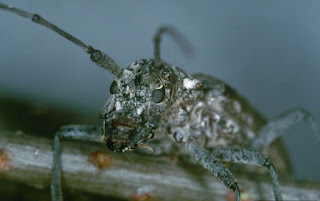
Pine sawyer beetles vector the nematodes that cause pine wilt.
Photo: L.D. Dwinell, USDA Forest Service, Bugwood.org
Because decline and death of a pine tree infested with Pinewood nematode occurs very quickly, it is usually too late to save a single tree. If there is a group of pine trees on the site insecticide treatments can be done in an effort to save the remaining trees. Dead branches should be pruned from live trees to reduce the attraction of pine sawyer beetles. Any dead pine trees or firewood should be removed or destroyed. Do not use the mulch from an infested tree for mulch. When replacing dead trees choose species which are immune to pine wilt such as Norway or Colorado blue spruce, Douglas-fir, cedar, hemlock or white pine trees.
The International Society of Arboriculture certified arborists at Owen Tree Service are experts at recognizing pine wilt in both young and mature trees. If your think your browning pine tree might have pine wilt give our arborists a call. Our company was founded on tree and shrub care services.
Blue stain fungus on pine logs.
Photo: L.D. Dwinell, USDA Forest Service, Bugwood.org
In addition to pest control services our experienced tree crews perform pruning trees or trimming shrubs and tree removal. Professional tree care services do not do topping of trees because of the harm it causes. Owen Tree Service can make trees smaller by proper crown reduction pruning.
Owen Tree Service provides lawn fertilization and weed control, in addition to insect and disease control for trees. We also have landscaping crews that can plant new trees or shrubs for you or apply organic mulch to freshen up your shrub beds.


